
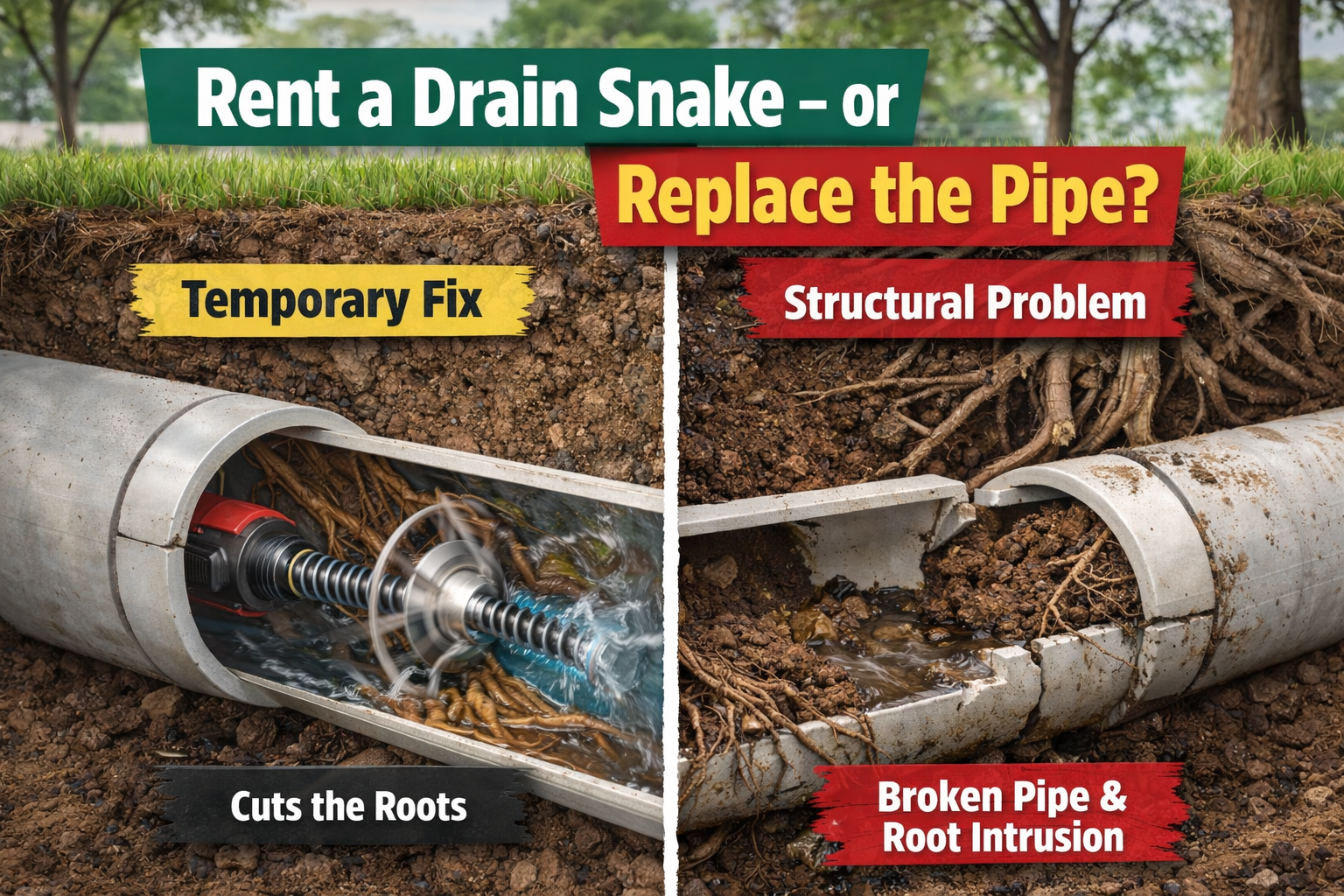
Tree roots are one of the most common causes of yard drain and sewer lateral problems. When drains slow down or sewage backs up, many homeowners consider renting a drain snake as a quick and inexpensive fix. Tool rental stores make it look straightforward: rent the machine, run the cable, cut the roots, problem solved.
In reality, root intrusion is often a structural pipe issue, not just a clog. Before renting a drain snake, it is important to understand what the tool can and cannot do, and when it may actually worsen the situation.
This guide walks through how tree roots invade yard drain lines, what different drain snake sizes actually accomplish, when DIY root cutting is reasonable, and when replacing part of the pipe is the more rational long-term investment.
Why Tree Roots Invade Yard Drain Lines
Tree roots do not “break” pipes out of aggression. They follow moisture and nutrients. Sewer laterals and yard drain lines provide both.
Most yard sewer lines are buried 2–4 feet deep. Over time, small vulnerabilities develop:
• Hairline cracks in PVC joints
• Slightly separated solvent-welded fittings
• Deteriorated gaskets in older pipes
• Clay or Orangeburg pipe with porous seams
• Minor pipe settlement causing joint gaps
Roots detect moisture vapor escaping from these micro-openings. Once inside, they expand. What starts as a thin strand can become a dense root mass over several seasons.

Common warning signs include:
• Water piles up at one or more drain openings after raining
• Slow draining speed
• Water overflow from the drain opening, especially for those connected to downspouts
• Intermittent backups that seem to “fix themselves”
These symptoms often appear before a full blockage occurs. Early intervention matters because repeated root growth enlarges pipe cracks over time.
What a Drain Snake Actually Does
A drain snake (also called a sewer auger) uses a rotating metal cable with a cutting head. When it encounters roots, it slices them into fragments or helps pull out the roots so water can pass again.

Drain snakes are the most sought-after tool for DIYers and professionals once drain problems happen. They are easily rented from hardware stores. However, it is critical to understand its limitation:
A drain snake cuts roots temporarily. It does not remove the root source. It does not seal pipe cracks. It does not fix pipe separation, sagging, or collapse.
If the structural opening remains, roots will regrow. In many cases, they return within 6–12 months.
The snake is therefore a maintenance tool, not a permanent repair.
Drain Snake Cable Sizes and What They Are Actually For

Many homeowners rent the wrong size machine. Cable diameter directly affects torque, cutting ability, and risk.
1/4″–3/8″ handheld auger
Designed for sinks and tubs.
Not appropriate for yard sewer lines.
Cannot handle roots in 3–4 inch pipe.
1/2″ cable machine
Works for light root intrusion in 2–3 inch pipe.
Limited torque for thicker root masses.
Suitable for minor blockages, not heavy invasion.
5/8″–3/4″ sectional cable machine
Used for 3–4 inch main sewer laterals.
Higher torque and stronger cutting heads.
Capable of cutting moderate root growth.
Higher risk of damaging offset joints or cracked PVC.
Most residential yard sewer lines are 3 or 4 inches in diameter. If roots are present, a 5/8″ or 3/4″ sectional machine is typically required. These machines are heavy and physically demanding. Improper operation can damage pipe walls or cause the cable to bind and whip.
Choosing too small a cable results in incomplete cutting. Choosing too large a cable increases the chance of structural damage if the pipe is compromised.
I recommend a 1/2” cable machine for most cases. It provides sufficient torque to cut through fibrous or hair-like roots while remaining flexible enough to navigate bends inside the pipe. At the same time, it carries a lower risk of damaging the pipe walls compared to larger, more aggressive cables.
When Renting a Drain Snake Makes Sense
There are situations where renting a machine is reasonable.
First-time clog with no history of root problems.
If drains recently slowed and you have never had root issues, a one-time rental may restore flow.
Newer PVC pipe with minor intrusion confirmed by camera.
If inspection shows small roots at a joint but no structural damage, cutting may buy time.
Budget constraints where temporary relief is acceptable.
If replacement is not immediately feasible, snaking can delay a larger expense.
Typical costs:
Machine rental: $60–$120 per day
Professional snaking: $250–$600
Hydrojetting: $400–$1,000
For homeowners comfortable with mechanical tools, renting once may be financially rational. However, it should be viewed as a maintenance strategy, not a cure.
When to Avoid DIY Snaking

Certain conditions make renting a drain snake a poor decision.
Recurring clogs every year
If you are cutting roots annually, the pipe opening is likely enlarging. Repeated cutting accelerates joint deterioration.
Old clay or Orangeburg pipe
These materials are fragile. Aggressive cable rotation can crack or delaminate them further.
Cable repeatedly binds at the same location
This may indicate offset joints, pipe belly, or collapse. Forcing the cable risks further structural damage.
Mud or soil on the cable
This suggests pipe breach and soil intrusion. At that point, the problem is structural.
In these cases, a camera inspection should come first. Running a heavy cable blindly can convert a repairable crack into a full replacement scenario.
Hydrojetting vs. Drain Snaking for Roots
Hydrojetting is another popular option for root invasion treatment. Here we provide brief discussion on Hydrojetting. Hydrojetting uses high-pressure water to scour pipe walls. Unlike a cable, it removes smaller root fragments and cleans grease buildup.
Advantages of hydrojetting:
• More thorough cleaning
• Reduces debris left behind
• Better for maintenance after cutting
Limitations:
• Does not fix structural cracks
• Can worsen collapse in severely damaged clay pipe
• Higher cost
Hydrojetting is often a better option when roots are moderate but the pipe is structurally intact. It should not be used in pipes already showing collapse or significant joint displacement without inspection.
When Pipe Replacement Is the Smarter Long-Term Move
Root intrusion often signals joint failure or pipe misalignment. In these cases, cutting roots repeatedly treats symptoms but not cause.
Replacement becomes logical when:
- Camera shows separated joints
- Pipe belly (sagging section holding water)
- Crushed or oval-shaped pipe
- Recurring roots within months of cutting
- Orangeburg pipe deterioration
Modern PVC replacement offers:
- Solvent-welded joints with tighter seals
- Improved slope correction
- Reduced long-term maintenance
- Lower probability of root re-entry

For localized damage, a spot repair may be sufficient. For extensive failure, full lateral replacement provides long-term reliability.
While replacement costs more upfront, repeated snaking over years often exceeds the cost of correcting the structural defect.
A Practical Decision Framework
Step 1: Confirm roots.
Use a cleanout inspection or rent a camera if possible.
Step 2: Assess severity.
Minor root strands in otherwise solid PVC may justify one-time snaking. Recommend to go with 1/2” drain snake if you decide to rent one.
Step 3: Evaluate history.
If this is recurring, a structural damage likely exists. Further drain snaking or hydrojetting will only provide temporary resolution.
Step 4: Look for structural defects.
If joints are separated or pipe is sagging, replacement is more cost-effective long term.
Step 5: Avoid blind force.
Never force a cable through resistance without understanding why it is binding.
This structured approach prevents turning a manageable issue into a major excavation project.
Frequently Asked Questions
Can a drain snake permanently remove tree roots?
No. It cuts them temporarily. Roots regrow unless the pipe defect is repaired.
What size drain snake is needed for a 4-inch sewer line?
Typically 5/8″–3/4″ sectional cable with appropriate cutting heads. But I recommend 1/2” cable for temporarily addressing root invasion, and plan for spot repairing the drain pipe.
Is hydrojetting better than snaking for roots?
It cleans more thoroughly but still does not fix structural pipe defects.
How often do roots return after snaking?
Commonly within 6–12 months if the entry point remains open.
Does cutting roots damage PVC pipe?
Improper use can enlarge cracks or stress offset joints.
Final remarks
Renting a drain snake can be a reasonable short-term solution for minor, first-time root intrusion in structurally sound PVC pipe. It is not a permanent repair and should not be repeated indefinitely without inspection.
If root problems recur, or if the pipe shows separation or sagging, structural correction is more rational than continued cutting.
The key distinction is this:
Snaking restores flow. Replacement restores integrity.
Understanding that difference helps homeowners avoid unnecessary damage and repeated expenses.


Leave a Reply