
Did you suddenly notice a water stain on the ceiling, water dripping near an AC vent, or standing water around your attic AC unit?
You may also notice water coming from an emergency drain pipe, a musty smell, or your AC suddenly shutting off.
These symptoms often point to an AC condensate drainage problem.
If your AC is leaking water, the problem is often not that the system is producing too much condensation. Air conditioners naturally produce water as they remove humidity from indoor air. The problem usually occurs when that water cannot drain properly.
A clogged condensate drain is a common cause, but a frozen coil, damaged drain pan, or drain pipe problem can cause similar symptoms.
Here’s how to figure out where the water is coming from and what to check first.
Is It Normal for an AC to Produce Water?
Yes.
Producing water is a normal part of air conditioning.
Warm indoor air passes over the cold evaporator coil inside your HVAC system. When the air cools, some of the moisture in it condenses on the coil—similar to water forming on the outside of a cold glass.
That condensation drips into a drain pan.
From there, it normally travels through a condensate drain line and leaves the HVAC system.
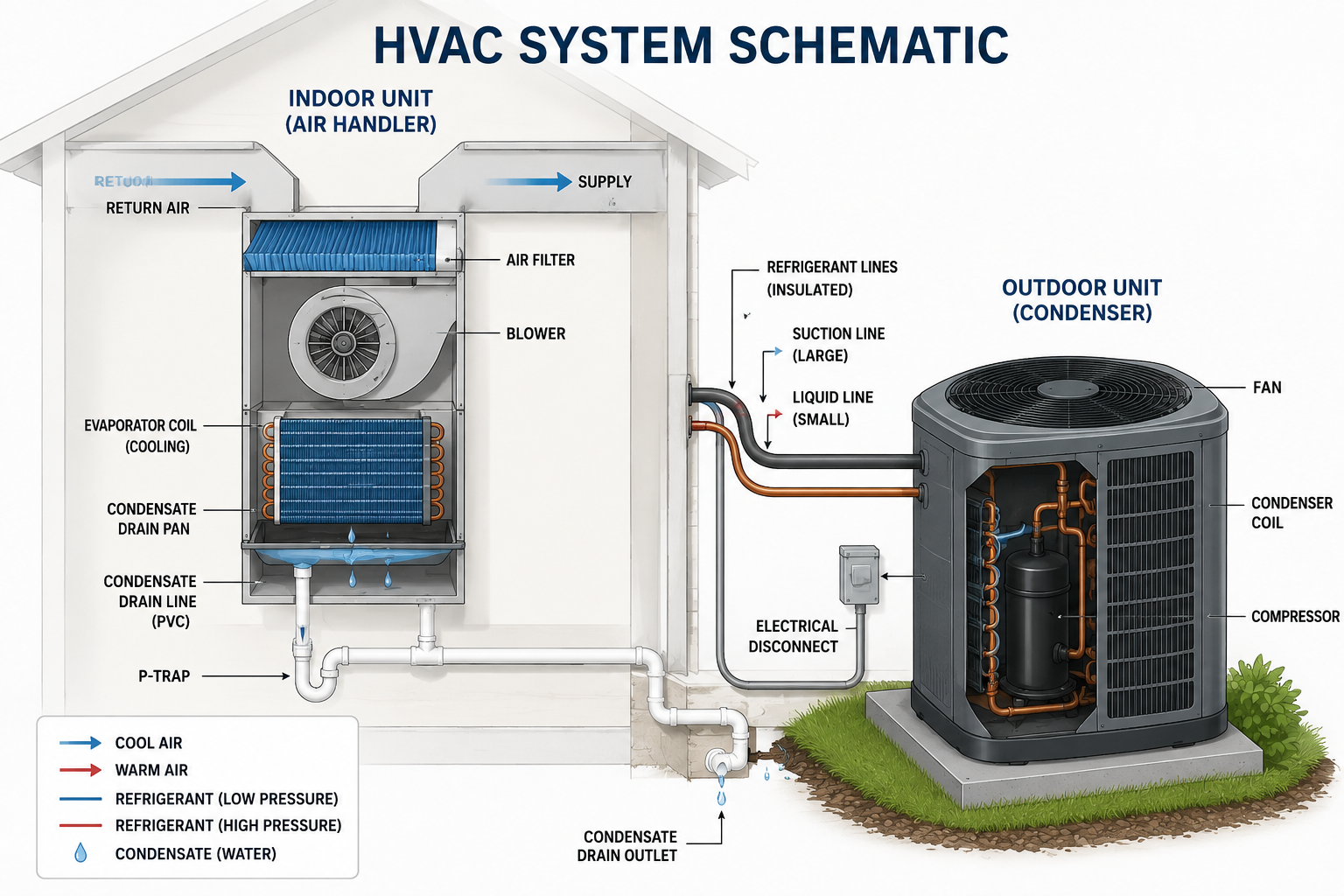
The basic path for the water condensation looks like this:
Evaporator coil → condensate drain pan → drain line → drain outlet
So simply seeing water coming from an AC condensate drain does not necessarily mean something is wrong.
In fact, during hot or humid weather, your AC may produce considerably more condensation than usual.

IMAGE: Simple diagram showing evaporator coil, drain pan, condensate drain line, P-trap, and drain outlet.
Why Is My AC Suddenly Producing So Much Water?
It is normal for an AC system to produce condensation. As warm, humid air passes over the cold evaporator coil, moisture condenses into water and drains away through the condensate drain line.
You may see more water than usual when:
- The weather is hot and humid.
- The AC runs for long periods.
- The system is removing a lot of moisture from the indoor air.
As long as the water flows normally through the drain, this usually isn’t a problem.
Most water problems happen when the condensate drain becomes partially or completely clogged. Dirt, dust, algae, and slime can build up inside the drain line, causing water to drain slowly or back up into the drain pan. If the blockage continues, the pan may overflow and water can leak around the AC unit—or even cause water stains on the ceiling if the unit is in the attic.
Signs of a possible clogged AC drain include:
- Standing water in the condensate pan
- Water around the indoor AC unit
- Little or no drainage from the normal outlet
- Water backing up at a cleanout
- A secondary drain pan filling with water
- AC shutting off because a float switch was triggered
This is why seeing “a lot of AC water” can be misleading.
The AC may not actually be producing an abnormal amount of water.
The water may simply have nowhere to go.
How to Clear a Clogged AC Condensate Drain
Safety first: Turn off the AC before working on the condensate drain. If water is near electrical components, or you cannot safely access the equipment, stop and contact an HVAC professional.
If you’ve confirmed that water is backing up because the condensate line isn’t draining, a wet/dry vacuum is often one of the simplest homeowner methods to try.
1. Turn Off the AC
Turn off the AC before working on the condensate drain.
2. Locate the Cleanout Port
Near the indoor AC unit, look for a vertical section of 3/4-inch PVC pipe with a removable cap. This is the condensate drain cleanout.
Remove the cap and look inside. Standing water or water that drains very slowly can indicate a blockage downstream.
3. Vacuum From the Exterior Drain Outlet
Next, locate the condensate drain outlet outside the house.
Most central AC systems use a 3/4-inch PVC condensate drain line. Outside the house, the outlet often looks like a short white PVC pipe sticking out of an exterior wall, usually a few inches to a foot above the ground.
Common places to look include:
- Near the outdoor condenser unit
- Along an exterior wall near the indoor AC unit
- Near the side or back of the house
- Near a utility area or garage wall
Some systems drain into a plumbing drain instead of directly outdoors, so you may not have an obvious exterior outlet.
If your system has a secondary or emergency drain, its outlet may be located higher on an exterior wall, above a window or another noticeable location. Water coming from this outlet can be a warning that the primary condensate drain is clogged.
Once you find the outlet, check whether water is dripping or flowing from it while the AC is running. If the AC has been running for a while but no water is coming out—and you see water collecting around the indoor unit or drain pan—a clogged condensate line is a likely cause.

Connect a wet/dry vacuum hose to the outlet and make the connection as airtight as possible. You can use a rag or duct tape around the hose to improve the seal.
Run the vacuum for about 1–2 minutes. The suction can pull water, algae, slime, and other debris through the drain line and out of the system.
4. Flush From the Cleanout Port

After vacuuming, slowly pour a small amount of water into the cleanout port.
Watch the exterior drain outlet. The water should flow out freely without backing up at the cleanout.
If it still drains slowly, vacuum from the exterior outlet again and repeat the flush.
5. Test the System
Once the drain flows freely, reinstall the cleanout cap and turn the AC back on.
After the system has been running, check that condensate is draining normally and that no water is accumulating in the drain pan or around the indoor unit.
If repeated vacuuming and flushing do not clear the line, the blockage may be deeper in the plumbing or the drain may have another problem that requires professional service.
How to Prevent Future AC Drain Problems
Basic maintenance can reduce condensate drainage problems, such as water leaks into your ceiling.
Regular AC maintenance can help reduce condensate drainage problems, especially before periods of heavy cooling. A few simple maintenance checks can reduce dirt and buildup in the condensate drain system:
- Replace the air filter regularly. A dirty filter allows more dust to reach the evaporator coil and drain pan.
- Check the condensate drain pan. Look for standing water, algae, slime, rust, or debris.
- Inspect the cleanout port. Make sure it is accessible and the cap can be removed when needed.
- Flush the condensate drain. Slowly pour warm water through the cleanout and confirm that it drains freely.
- Check the outdoor drain outlet. While the AC is running, make sure condensate is actually dripping or flowing from the expected outlet.
- Keep the drain outlet clear. Remove dirt, leaves, insects, or landscaping that may obstruct the pipe.
- Look for slow drainage. Water backing up at the cleanout or remaining in the drain pan can be an early sign of a developing clog.
- Inspect around the indoor AC unit. Watch for water stains, damp insulation, rust, or moisture around the air handler.
- Check the evaporator coil visually if accessible. Excessive dust or debris can contribute to condensate and drainage problems. Avoid disassembling the HVAC system to reach it.
- Check more frequently during heavy AC use. Long cooling cycles and humid weather can produce significantly more condensate.
Catching slow drainage early is much easier than dealing with an overflowing drain pan or water damage after the line becomes completely blocked.
When Should You Call an HVAC Technician?
Consider professional service if:
- Water is leaking into a ceiling or wall.
- The condensate pan continues overflowing after the drain is cleared.
- The evaporator coil is freezing.
- The AC is not cooling properly.
- The drain repeatedly becomes clogged.
- The condensate piping is inaccessible.
- The drain pan is cracked or corroded.
- Water is near electrical components.
- You cannot determine where the water is coming from.
If the problem is simply a clogged accessible drain line, the repair may be relatively straightforward.
If drainage is normal but the AC is still producing unusual water or leaking, further HVAC diagnosis may be necessary.
Frequently Asked Questions
Why is my AC producing so much condensation?
High indoor humidity, hot weather, and long cooling cycles can all increase condensation. If the water drains normally, increased condensation may be normal. If water is backing up or leaking around the HVAC equipment, check the condensate drain and drain pan.
Is it normal for AC to drip a lot of water outside?
It can be. During hot and humid weather, an air conditioner may remove a significant amount of moisture from indoor air. Water dripping from the proper condensate outlet is generally less concerning than water accumulating around the indoor unit.
Why is there water around my indoor AC unit?
Common causes include a clogged condensate drain, overflowing drain pan, frozen evaporator coil, cracked pan, or leaking drain connection.
How do I know if my AC drain line is clogged?
Standing water in the drain pan, water around the air handler, little drainage from the normal outlet, or water backing up at the cleanout can indicate a blockage.
Why is my AC producing water but not draining?
A blockage in the condensate line is one possibility. Check the pan, drain opening, P-trap, drain pipe, and outlet for restrictions.
Can high humidity make my AC produce more water?
Yes. The more moisture your AC removes from indoor air, the more condensate it produces. Higher humidity can therefore noticeably increase condensate drainage.
The Bottom Line
A lot of water coming from your AC is not automatically a problem.
Air conditioners are supposed to produce condensation.
The important question is where that water is going.
If it is flowing freely through the normal condensate drain, increased water during hot or humid weather may be completely normal.
If water starts collecting in the drain pan, leaking around the air handler, coming from an emergency drain, or appearing through a ceiling, inspect the condensate drainage system.
A clogged drain line is one common cause—but it isn’t the only one.



Leave a Reply