

Does your pool turn cloudy more easily than it used to, even when the
chlorine level appears normal? Are the return jets weaker, or is the
pressure gauge slowly climbing?
These symptoms can indicate that the pool filter needs service.
However, no single pressure reading or cleaning schedule works for every
pool. The best approach is to compare how your system performs now with
how it operates when the filter is clean.
Here are six signs you can observe before opening the filter or
taking anything apart.
The Short Answer
The most reliable sign is pressure that has risen above your filter’s
clean starting pressure. Many manufacturers use a service point
approximately 8–10 PSI above that baseline, but the instructions for
your exact filter take precedence.
Other clues include weaker return flow, ineffective skimming, a
slower suction-side cleaner, recurring cloudiness despite verified water
chemistry, and water taking longer to clear.
| What you observe | What it may indicate |
|---|---|
| Pressure has risen from the clean baseline | Increasing resistance through the filter |
| Return jets feel weaker | Reduced circulation through the system |
| Surface debris is not reaching the skimmer | Lower skimming flow |
| A suction-side cleaner moves slowly | Reduced suction or another flow restriction |
| Water becomes cloudy easily | Suspended material is not being removed effectively |
| The pool takes longer to clear | Filtration performance may have declined |
These signs are most meaningful in combination. They can also be
caused by other circulation or chemistry problems, so perform the simple
checks described below before concluding that the filter is
responsible.

1. Pressure Is
Higher Than the Clean Baseline
There is no universal “good” pool-filter pressure.
A reading of 20 PSI could be normal for one pool and unusually high
for another. Pipe length, pipe diameter, filter size, pump speed, valve
position, elevation, heaters, and water features all affect system
pressure.
What matters is how the current reading compares with your own
clean pressure: the stable gauge reading after the
filter has been properly serviced and the system has returned to normal
operation.
When establishing or comparing the baseline:
- Use the same pump speed.
- Return the valves to their normal positions.
- Make sure the pool-water level is normal.
- Empty the skimmer and pump baskets.
- Bleed trapped air according to the filter manual.
- Wait for the flow and pressure to stabilize.
Record the number in your phone, write it on the equipment with a
removable marker, or use the clean-pressure marker on the gauge.
Follow the service threshold specified for your model. Many manuals
call for cleaning or backwashing when pressure rises roughly 8–10 PSI
above clean starting pressure. Some pool-maintenance resources instead
use a percentage increase. The manufacturer’s instructions should
control.
Also check whether the gauge returns to zero when the pump is off. A
gauge that sticks above zero, jumps erratically, or barely changes
between pump speeds may be unreliable.

2. Return Jets Feel Weaker
As debris accumulates in the filter media, water becomes harder to
push through it. You may feel less water coming from the return jets
even though the pump is running at its usual speed.
Before blaming the filter, check for simpler causes:
- Low pool-water level
- A full skimmer basket
- A clogged pump basket
- A blocked cleaner or suction line
- A valve in the wrong position
- Air entering the suction side
- A pump-speed setting that was recently changed
The relationship between pressure and flow is useful:
- Weak flow with pressure above baseline more
strongly suggests resistance at or after the filter. - Weak flow with unusually low pressure more often
points to inadequate water reaching the pump, a suction-side
restriction, or a pump problem.
3. Skimming Becomes Less
Effective
Leaves, insects, and other surface debris may circulate around the
pool instead of being drawn efficiently into the skimmer.
Wind direction and water level affect skimming, so compare
performance under reasonably similar conditions. If surface collection
has gradually weakened while the pump speed and valve positions remain
unchanged, reduced system flow may be contributing.
Check the skimmer basket and weir door first. A jammed weir or
overfilled basket can imitate a dirty-filter problem.
4. A Suction-Side Pool
Cleaner Slows Down
A cleaner connected to the pool’s suction system depends on adequate
water flow. It may move more slowly, stop frequently, remain near the
edge, or cover less of the pool when circulation is restricted.
Before suspecting the filter, check:
- The cleaner for trapped debris
- Each hose section for a blockage or air leak
- The skimmer and pump baskets
- The cleaner-flow setting
- Suction-valve positions
- The pool-water level
If those conditions are normal and the pressure gauge is also
elevated, the filter becomes a stronger suspect.

5. The Water Becomes Cloudy
Easily
Chlorine and filtration perform different jobs. Chlorine helps
sanitize the water and control algae, while the filter physically
removes suspended particles. A pool can therefore have an apparently
adequate chlorine reading and still look cloudy when filtration or
circulation is inadequate.
In my case, the water began becoming cloudy easily even when the
measured chlorine level was normal or near the high end of its intended
range. Together with the filter-pressure behavior, that made
filtration—not simply a lack of added chlorine—a stronger suspect before
I opened anything.
The two observations were more meaningful together:
- Rising pressure suggested increasing resistance
through the filter. - Recurring cloudiness suggested that fine suspended
material was not being removed effectively.
Cloudiness alone does not prove that the filter needs cleaning.
Verify that you are measuring free chlorine, not relying only on total
chlorine, and that the free-chlorine target is appropriate for the
pool’s cyanuric acid (CYA) level. Also consider pH, combined chlorine,
pump runtime, circulation, swimmer load, windblown debris, and possible
early algae growth.
The useful question is not merely, “Is there chlorine in the water?”
It is:
Does the cloudiness keep returning even after chemistry, circulation,
and pump runtime have been checked?
6. The Pool Takes
Longer to Become Clear
After swimming, wind, rain, brushing, vacuuming, or another routine
disturbance, the water may remain hazy longer than it did previously
under similar conditions.
This comparison is most useful when the following have remained
reasonably consistent:
- Water chemistry
- Pump speed and runtime
- Number of swimmers
- Weather and debris load
- Cleaning method
A longer clearing time does not identify the exact problem, but
combined with higher pressure or weaker circulation, it strengthens the
case for filter service.
Look for a Pattern, Not
Just One Symptom
The strongest indication is usually a combination of observations
rather than one isolated symptom.
For example:
| Combination | What to check next |
|---|---|
| High pressure + weak returns | Filter restriction is likely; verify baskets and valves first |
| High pressure + recurring cloudiness | Filter may be loaded or struggling with a heavy contaminant load |
| Weak cleaner + weak skimming + high pressure | Overall circulation is likely being restricted |
| Cloudiness alone | Verify chemistry, CYA relationship, circulation, and runtime first |
| Weak flow + low pressure | Investigate the suction side or pump before assuming the filter is dirty |
What Should You Do Next?
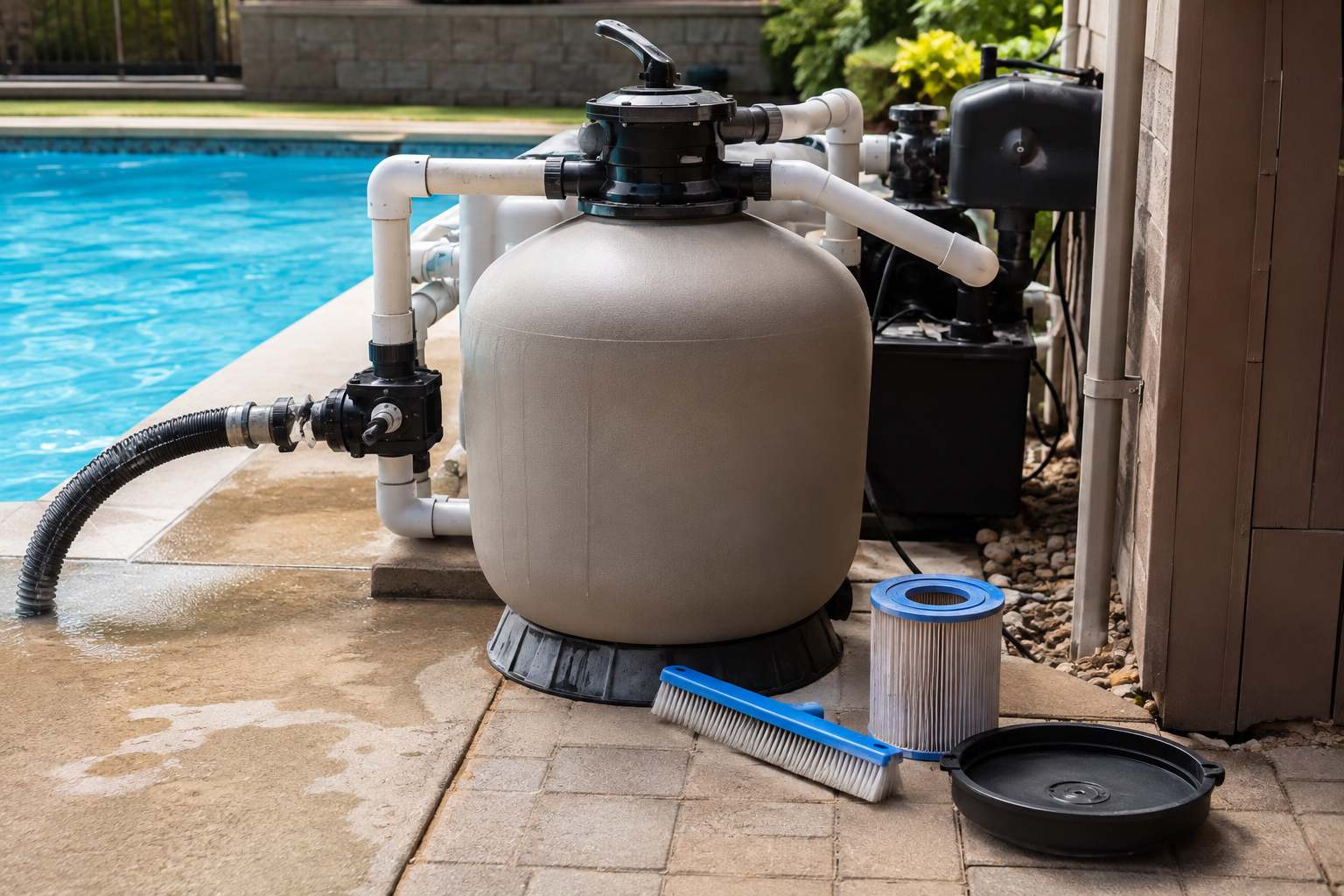
Once the observations point toward the filter, identify the exact
filter type and model before servicing it. Sand filters, cartridge
filters, traditional grid-style DE filters, and modular DE filters are
not cleaned in the same way.
The next decision is whether the filter should be backwashed or
opened for a full cleaning. Some filters are routinely backwashed, some
must be opened and rinsed, and some modular designs have model-specific
requirements.
Internal link: Should
You Backwash or Open Your Pool Filter? How to Decide
Final Takeaway
Do not service a pool filter solely because a generic PSI number
sounds high or because a calendar says it is time. Compare pressure with
your clean baseline and look for changes in circulation and water
clarity.
The six most useful signs visible before opening anything are:
- Pressure has risen from the clean baseline.
- Return flow is weaker.
- Skimming is less effective.
- A suction-side cleaner moves more slowly.
- Water becomes cloudy easily despite verified chemistry.
- The pool takes longer to clear.
When several appear together—and basic chemistry, baskets, water
level, valves, and pump settings have been checked—the filter is a
reasonable next place to investigate.
Frequently Asked Questions
Is 20 PSI too high for a
pool filter?
Not necessarily. If clean pressure is 18 PSI, a reading of 20 PSI may
be normal. If clean pressure is 10 PSI, a reading of 20 PSI may indicate
that service is overdue. Compare the reading with your own baseline and
filter manual.
Why is my
pool cloudy when chlorine is normal or high?
The filter may not be removing suspended material effectively, but
chemistry still needs to be verified. Confirm that free chlorine is
appropriate for the pool’s CYA level and check pH, combined chlorine,
circulation, and pump runtime before assuming that the filter is
responsible.
Can a dirty filter
make the return jets weak?
Yes. Accumulated material can restrict water passing through the
filter. However, clogged baskets, low water level, incorrect valves,
suction blockages, air leaks, and pump problems can produce similar
symptoms.
Should I clean
the filter on a fixed schedule?
Use the manufacturer’s maintenance requirements, but also watch the
pressure rise and system performance. A pool dealing with algae, heavy
debris, or frequent use may need service much sooner than a lightly used
pool.

Leave a Reply