
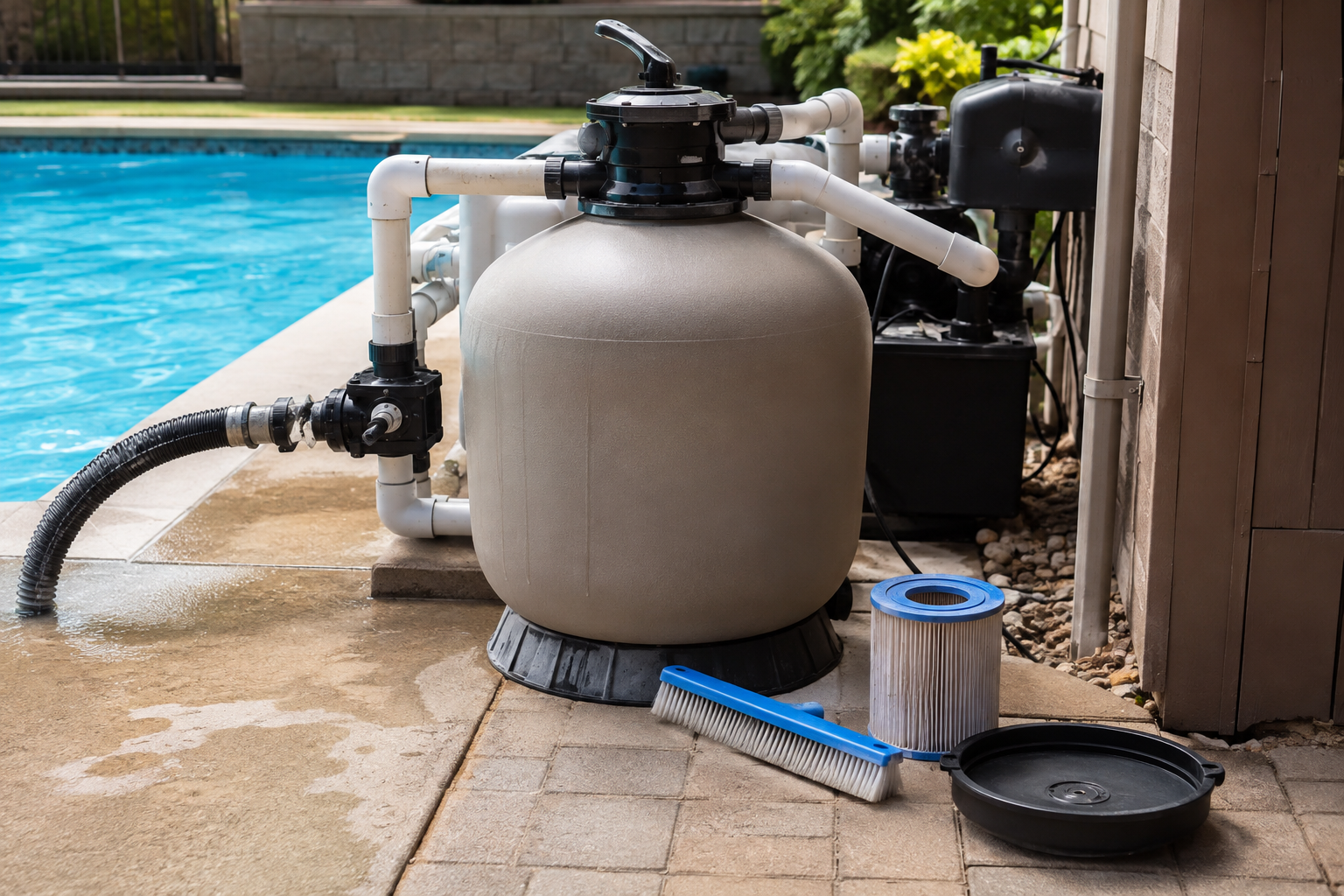
Once the signs point toward a dirty pool filter, there is a second
question: should you backwash it, or open the tank and clean the filter
elements?
The answer depends first on the filter type. It also depends on what
happens after routine service. A successful backwash should restore
meaningful flow and bring pressure reasonably close to the established
clean baseline. If it does not, the filter may require a full internal
cleaning or inspection.
If you are not yet sure whether the filter needs service, start
here:
First,
check the signs that your pool filter needs service.
The Short Answer
- Sand filters are normally backwashed for routine
cleaning. - Cartridge filters are opened and rinsed; they are
not backwashed. - Traditional grid-style DE filters can often be
backwashed, but periodically need to be opened and cleaned. - Modular DE filters vary by model. Some support
backwashing, while others are designed primarily to be opened and
rinsed.
Never assume the method or DE quantity from appearance alone. Find
the manufacturer and complete model number and follow its manual.

share the same routine cleaning method.
Backwashing vs. Full Cleaning
Backwashing reverses water flow through the filter and discharges
loosened material through a waste line. It is faster and does not
require opening the pressurized tank, but it may not remove deposits
held deep within the media.
A full cleaning requires shutting down and depressurizing the system,
opening the tank, removing or exposing the filter elements, rinsing them
thoroughly, and inspecting internal components.
| Situation | Likely approach |
|---|---|
| Sand filter reaches its service pressure | Backwash and rinse according to the manual |
| Backwashable DE filter reaches its service pressure | Backwash, then recharge with the specified amount of DE |
| Cartridge filter needs service | Open the tank and rinse the cartridges |
| Pressure and flow recover normally after backwashing | Resume normal filtration and monitor |
| Backwashing produces little improvement | Full cleaning or further troubleshooting may be needed |
| Pressure rises again unusually quickly | Consider heavy algae/debris load or incomplete cleaning |
| Filter media appears at the returns | Shut down and inspect for damage or incorrect assembly |
Start by Identifying the
Filter
Look for the label on the tank and record:
- Manufacturer
- Full model number
- Filter type
- Filter area or size
- Backwash-valve arrangement
- Required media and quantity
This is especially important for product families that include
several internal designs. “Sta-Rite System 3,” for example, is not
enough information by itself; System 3 variants do not all use identical
media or cleaning procedures.
Sand Filters
Sand filters are normally cleaned by backwashing. Water flows
backward through the sand bed, loosening accumulated material and
carrying it out through the waste line.
If the valve has a Rinse position, use it after
backwashing and before returning to Filter. Always turn
the pump off before moving a multiport valve.
Routine cleaning normally does not require opening the tank. Internal
inspection becomes more appropriate when backwashing no longer restores
performance or when you suspect channeling, contaminated media, or
damaged laterals.
Cartridge Filters
Standard cartridge filters are not backwashed. Turn off the pump,
prevent automatic startup, isolate the equipment if required, release
all pressure, and open the tank according to the manual.
Remove the cartridges and rinse between the pleats with a garden
hose. Excessive spray pressure can damage the fabric, so avoid a
pressure washer unless the manufacturer explicitly permits it.
If ordinary rinsing does not remove oily or mineral deposits, use
only a compatible treatment recommended for the filter material.
Traditional Grid-Style DE
Filters
Many grid-style DE filters can be backwashed for routine service.
After backwashing, they must be recharged with fresh DE according to the
manufacturer’s directions.
Backwashing does not necessarily remove every deposit. A periodic
teardown allows you to rinse the grids thoroughly and inspect the
manifold, grid fabric, air-bleed assembly, internal connections, and
tank seal.
Use the exact recharge quantity specified for the model and
procedure. The amount used after a backwash may differ from the amount
used after a complete teardown.
Modular DE Filters
Modular DE filters can resemble cartridge filters internally because
the DE coats pleated modular elements instead of a conventional
curved-grid assembly. However, they still require the correct DE
coating.
Some modular DE filters support backwashing; others are designed to
be opened and rinsed without a backwash valve. Confirm the exact model
before choosing a procedure.
My filter is a Sta-Rite System 3 modular DE filter.
When I opened it, the pleated elements were heavily coated with old DE
and captured debris. The buildup illustrates why a full cleaning can
reveal material that cannot be evaluated from the pressure gauge or
outside of the tank.

and old DE had accumulated heavily across the pleated elements.

before reassembly and recharging with the manufacturer-specified amount
of fresh DE.
Use the Pressure-Recovery
Test

Meaningful recovery is evidence that the chosen service method
worked.
The pressure before service helps indicate that the filter may be
restricted. The pressure afterward helps show whether the chosen
cleaning method was enough.
- Record pressure at the normal pump speed before service.
- Backwash or clean the filter according to its manual.
- Recharge the filter media if required.
- Restore the usual valve positions and pump speed.
- Bleed trapped air and allow pressure to stabilize.
- Compare the new reading with the clean baseline.
Also compare return flow, skimming, cleaner performance, and clearing
time.
| Result | What it suggests |
|---|---|
| Pressure returns near baseline and flow improves | Routine service was probably successful |
| Pressure falls only slightly after backwashing | Material may remain inside the filter |
| Pressure is normal but flow remains weak | Check suction restrictions, valves, baskets, pump, and return plumbing |
| Pressure remains high after full cleaning | Check valve position, gauge, return restrictions, and filter-media quantity |
| Pressure rises rapidly during algae cleanup | The filter may be capturing a heavy load of dead algae |
When Backwashing Is
Probably Enough
For a filter designed to be backwashed, it is a reasonable first step
when:
- Pressure has reached the service point in the manual.
- Flow has gradually weakened.
- The pool recently experienced heavy dust, debris, or dead
algae. - Previous backwashing restored normal pressure and flow.
- There are no signs of media returning to the pool.
Afterward, return every valve to its correct position, replace any
required filter media, bleed air, and record the stabilized
pressure.
When to Open the Filter
A full cleaning or inspection is more appropriate when:
- Backwashing does not bring pressure reasonably close to
baseline. - Pressure rises again unusually quickly without an obvious heavy
debris load. - The manufacturer’s maintenance schedule calls for an internal
cleaning. - The filter has not been opened for an extended period.
- DE powder, sand, or debris appears at the return jets.
- The tank seal leaks or internal damage is suspected.
A Helpful Video
for Sta-Rite System 3 Owners
For a Sta-Rite System 3 modular DE filter similar to mine, this video
provides a useful visual walkthrough:
Sta-Rite System 3
Modular DE Pool Filter Cleaning
It shows how this particular tank opens, how the modular elements are
handled and rinsed, and how the system is reassembled and recharged. Use
it as a visual companion, not a substitute for the owner’s manual.
Confirm the exact model, DE quantity, valve arrangement, and reassembly
procedure before beginning.
Important Safety Steps
A pool filter is a pressurized vessel. Never loosen a clamp, locking
ring, lid, gauge, or fitting while the system is running or
pressurized.
Before opening the tank:
- Turn off power and prevent the pump from starting
automatically. - Position valves as required by the manual.
- Open the manual air-relief valve.
- Confirm that all pressure is released and the gauge reads zero.
- Follow the manufacturer’s procedure for the clamp or locking
mechanism.
Before restarting, inspect the tank seal and locking components and
reassemble them exactly as directed. Stand clear of the lid while the
system pressurizes. Stop and call a professional if the tank, clamp,
locking ring, or pressure gauge is damaged or cannot be seated
correctly.
Final Takeaway
Backwashing and full cleaning are not interchangeable. Backwashing is
routine service for many sand and DE filters, while cartridge filters
must be opened. Modular DE filters require model-specific
instructions.
If the filter supports backwashing, use the pressure-recovery test:
compare pressure and flow before and after service under the same
operating conditions. If performance does not return reasonably close to
the clean baseline, it may be time to open and thoroughly clean the
filter.
Frequently Asked Questions
Can I backwash a cartridge
filter?
No. Standard cartridge filters are opened and rinsed. Do not add a
backwash arrangement unless the manufacturer designed the filter for
it.
Do I need to add DE after
backwashing?
Yes. A DE filter must be recharged according to its manufacturer’s
instructions after backwashing or full cleaning. Use the quantity
specified for the exact model and procedure.
Why did
backwashing lower pressure only slightly?
Material may remain on or inside the filter elements, but also check
the pressure gauge, valve position, return-side restrictions, and
filter-media quantity. A full cleaning may be needed if simpler checks
do not explain the reading.


Leave a Reply