
When I first decided to replace the carpet in our home, I assumed the hardest part would be installation. I was wrong.
The real challenge was much earlier:
I didn’t know anything about flooring.
Hardwood, engineered wood, laminate, vinyl—everything sounded familiar, yet nothing was actually clear. Prices varied wildly, recommendations conflicted, and most explanations assumed prior knowledge I simply didn’t have.
What the Floor Is Actually Made Of (In Plain Language)
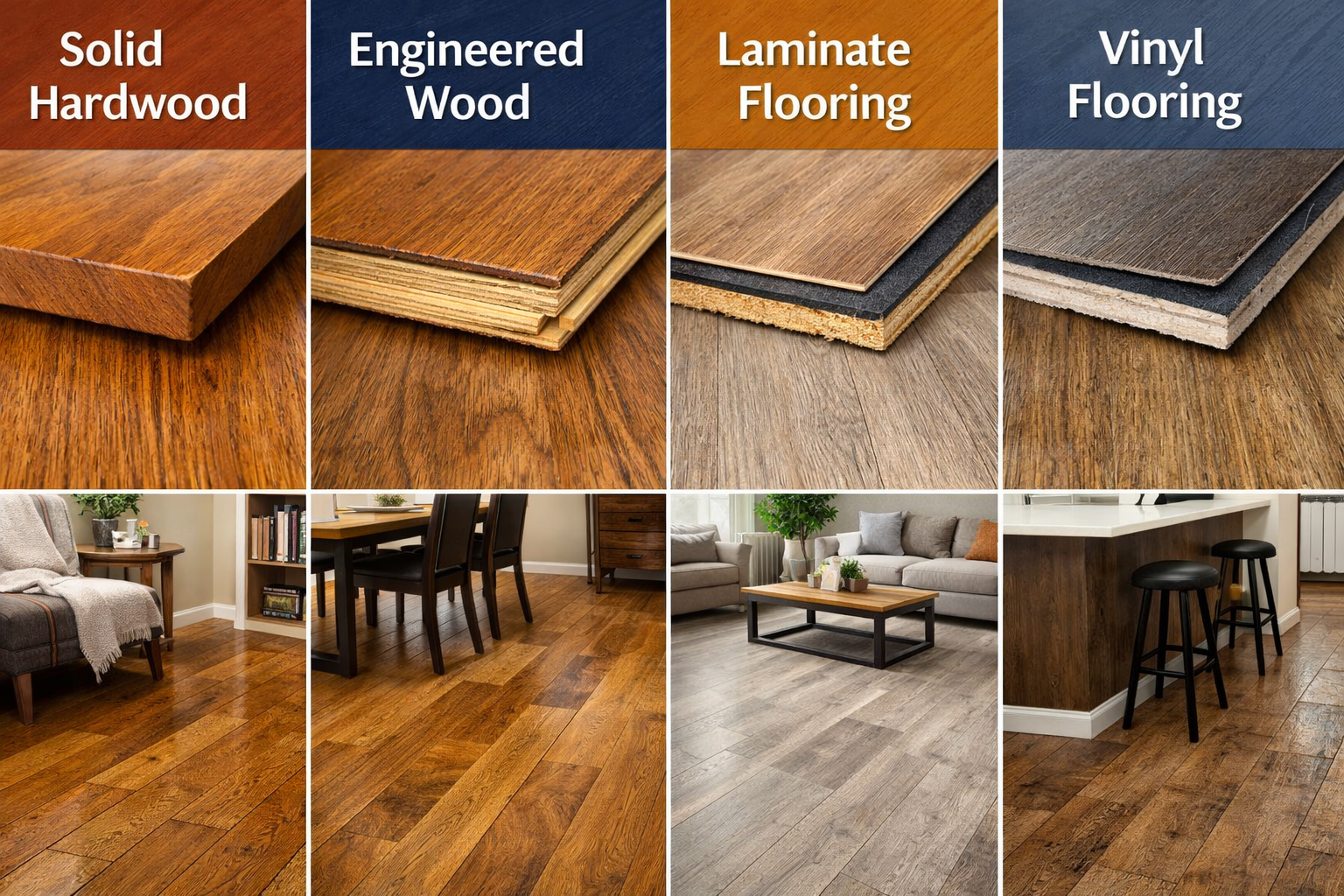
At a fundamental level, flooring types differ not by appearance, but by how much real wood they contain and how much glue or synthetic material is required to hold them together. These design choices directly affect indoor air quality, maintenance effort, and how the floor wears over time.
- Solid hardwood
Made from a single, continuous piece of real wood. Because there are no internal layers, it requires no structural glue inside the board itself. This typically results in minimal off-gassing once installed. However, solid wood expands and contracts naturally, which means it is more sensitive to moisture and wear. Over time, it usually requires periodic waxing and refinishing, especially in high-traffic areas. - Engineered wood
Built with a real hardwood surface layer bonded to multiple layers of plywood underneath. The layered design uses glue, but because the layers are relatively large and cross-oriented, the glue-to-wood ratio is moderate. High-quality engineered wood with low-VOC adhesives tends to have very mild odor and good indoor air quality. The layered structure improves stability, and factory-applied finishes mean no waxing is needed, with wear resistance and maintenance falling between solid wood and synthetic floors. - Laminate flooring
Contains no real wood on the surface. The core is made of compressed wood particles glued together with resins, topped by a printed plastic wear layer. Because small wood fibers require more adhesive to bind, laminate generally has a higher glue content, which can lead to stronger odors depending on product quality. While laminate resists surface scratches well, damage cannot be repaired—worn or swollen planks must be replaced, not refinished. - Vinyl / SPC flooring
Made entirely from plastic or stone–plastic composites, with no wood content. It does not rely on wood-based adhesives but introduces plasticizers and chemical additives. Maintenance is minimal and moisture resistance is excellent, but scratches and dents are permanent, and long-term wear does not improve with refinishing.
In practice, materials that rely less on glue and more on solid structure tend to have better indoor air quality and more forgiving aging, while materials engineered for durability often trade repairability for ease of maintenance.
Table 1. Material Structure, Glue Usage, and Wear Behavior by Flooring Type
| Flooring Type | What It’s Made Of | Indoor Air Quality & Baby Safety | Maintenance & Daily Wear | Estimated Cost |
| Solid Hardwood | One solid piece of real wood from top to bottom | Very low off-gassing after install; odor mainly from surface finish | Wax every 6–12 months; refinish every 7–10 years; sensitive to moisture and dents | $10–28 / sq ft |
| Engineered Wood | Real wood surface layer over plywood layers | Low odor if low-VOC adhesives are used; generally baby-safe when certified | No waxing; factory-finished; possible light refinishing depending on wear layer | $7–16 / sq ft |
| Laminate | Printed plastic surface over compressed wood fibers glued with resin | Odor varies widely; higher glue content makes certification important | No waxing; scratch-resistant surface; damaged planks must be replaced | $1–5 / sq ft |
| Vinyl / SPC | Fully plastic or stone–plastic composite materials | No wood odor; possible plastic smell initially depending on formulation | Very low maintenance; moisture-resistant; permanent scratches | $1–10 / sq ft |
Assumptions: typical U.S. residential pricing, standard installation, no major subfloor repair. Actual costs vary by region, labor rates, and floor layout.

Figure 1. Flooring Materials Compared by Structure, Emissions, and Wear Behavior
Given our priorities—baby safety, indoor air quality, pet-friendly, manageable maintenance, and real wood feel—engineered wood emerged as the most balanced option.
Solid hardwood was appealing in theory, but its sensitivity to moisture and higher ongoing maintenance especially with dog at home made it less practical for our household. Laminate and vinyl were easier to maintain, but involved either heavy glue usage or fully synthetic materials.
Engineered wood sat squarely in the middle: real wood on the surface, better dimensional stability, and predictable maintenance—without the lifestyle trade-offs of solid wood.
Engineered Wood: Why Prices Can Be 2–3× Different (Plain Logic)
Once I decided on engineered wood, a new question appeared:
Why do engineered wood floors that look almost identical vary so much in price?
If you only remember one rule about engineered wood, it’s this:
The more “thick, good real wood” a floor contains, the more expensive it gets.
Everything else—layers, glue, smell, durability—ultimately comes from that.
The Core Logic (in one minute)
Engineered wood is basically a “wood sandwich”:
- Top = real hardwood (what you see and walk on)
- Middle = the support core (what makes it stable or cheap)
- Bottom = balancing layer (helps reduce warping)
Now the pricing logic becomes simple:
- Same quality wood → thicker = more expensive
More wood is literally more material. - Same thickness → fewer layers = more expensive
Because fewer layers usually means larger, higher-quality pieces of wood (not chopped material).
Fewer layers also tends to mean less glue, which usually means less smell and better indoor air quality. - The “middle core” decides whether it’s premium or budget
If the core is made from good plywood layers, it’s more stable and often cleaner.
If it’s made from wood fibers/particles glued together, or mixed/cheap filler (or synthetic layers in some products), it’s cheaper—but tends to have more odor risk and a different feel underfoot.

Figure 2. Engineered Wood Explained as a “Wood Sandwich”
The Main Differences That Create Quality Gaps in Engineered Wood
1. Three-Layer vs. Multi-Layer Construction
“Big wood sheets” vs. “many thin sheets”
- Three-layer engineered wood:
Uses fewer, thicker pieces of real wood (top layer + thick middle layer + backing layer), which typically means larger wood sheets, less glue overall, and a higher cost at the same thickness. - Multi-layer engineered wood (7–11 layers):
Uses many thin plywood layers bonded together, which increases stability but also increases glue usage; quality and odor depend heavily on plywood grade and adhesive standards.
2. Wear Layer Thickness
How much real wood you are actually buying
- Thicker wear layer (≈4–6 mm):
Contains more real hardwood, costs more, ages better over time, and can usually be refinished once or twice. - Thinner wear layer (≈1–3 mm):
Uses less real wood, costs less, and is mainly cosmetic with limited or no refinishing potential.
3. Core Material (Middle Layer)
Real wood sheets vs. glued fibers
- Plywood core (birch, eucalyptus, or similar):
Made from layers of real wood sheets with alternating grain direction, resulting in better structural stability, more natural feel underfoot, and generally more predictable indoor air quality. - HDF / particle-based core:
Made from compressed wood fibers and resin, which lowers cost but increases reliance on glue and can change moisture behavior and odor profile.
4. Glue and Environmental Standards
Less glue vs. better glue
- Low-VOC / NAUF adhesives with certification:
Typically used in higher-quality engineered wood, resulting in mild or barely noticeable odor and better suitability for homes with babies. - Standard resins with minimal certification:
Common in lower-priced products, with greater variability in smell and indoor air quality depending on formulation and manufacturing controls.
Engineered Wood Brands by Structural Quality and Price
(with Estimated Total for 2000 sq ft)
| Quality Tier | Typical Construction | Wear Layer | Core Material | Glue & Environmental Standards | Representative Brands* | Typical Price (Material Only) | Estimated Total for 2000 sq ft (Material + Install) |
| Budget | Multi-layer (many thin layers) | Thin (≈1–2 mm) | HDF / particle-based | CARB compliant; basic resin; odor varies by product | Big-box house brands, entry lines from large manufacturers | ~$4–6 / sq ft | $14,000 – $20,000 |
| Mid-Range | 3-layer or quality multi-layer | Medium (≈2.5–3 mm) | Plywood core | Low-VOC adhesives; generally baby-safe | LW Flooring (higher lines), Kahrs mid-tier, similar regional brands | ~$6–9 / sq ft | $18,000 – $26,000 |
| Premium | 3-layer or premium multi-ply (7–11 layers, high-grade plywood) | Thick (≈4–6 mm) | High-grade multi-ply plywood | NAUF / ultra-low VOC; strong third-party certification | Mirage, Kahrs premium lines, high-end European brands | ~$9–14+ / sq ft | $26,000 – $36,000+ |
Based on these factors, I didn’t start by picking a brand. I first chose a quality tier.
We decided on a premium-tier engineered wood—3-layer, with a thick wear layer, high-grade plywood core, and strong low-VOC environmental standards. This tier offered the best balance of indoor air quality, stability, and long-term durability for a home with a baby and a dog.
In the next blog, we will cover what made the final purchase both satisfying and cost-effective.

Leave a Reply